Anxiety activates the body’s threat response. Heart rate climbs. Breathing becomes shallow. The mind fixates on what could go wrong. In this state, logical reassurance rarely works — your nervous system isn’t interested in logic right now.
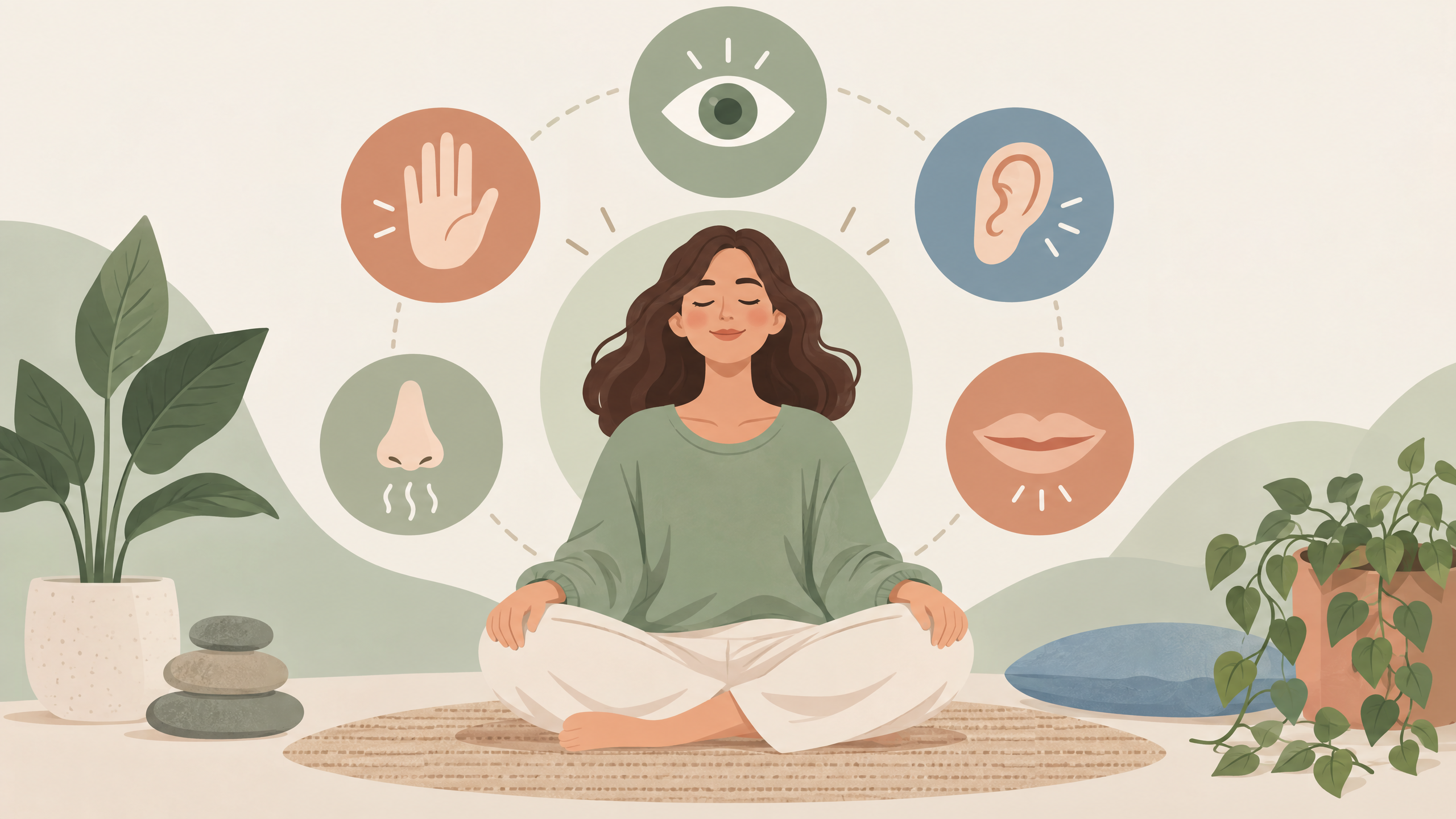
Grounding techniques work differently. They interrupt the anxiety spiral by redirecting attention to present-moment sensory experience — what you can see, hear, feel, and touch right now. This anchors you in the present rather than the catastrophic futures your anxious mind is generating.
These techniques are used in CBT, EMDR, trauma therapy, and dialectical behaviour therapy (DBT). They’re evidence-based, fast-acting, and require no equipment.
The 5-4-3-2-1 Grounding Technique
This is the most widely used grounding technique, and for good reason: it works quickly, can be done anywhere, and is simple enough to remember during a moment of acute anxiety.
How to do it:
Pause wherever you are. Breathe slowly. Then work through each of the five senses:
5 things you can SEE. Look around and name five things in your immediate environment. Not things you know are there — things you’re actually looking at right now. The grain of the desk surface. The shadow the window frame casts. The colour of the chair across the room.
4 things you can TOUCH. Notice the physical sensations of contact. Your feet on the floor. The texture of your clothing against your skin. The temperature of the air on your hands. The weight of your body against the chair.
3 things you can HEAR. Listen carefully. Background sounds you’ve been filtering out — traffic, air conditioning, distant voices, your own breathing.
2 things you can SMELL. This one can take a moment. Coffee. Fresh air. Your own hand cream. The room itself.
1 thing you can TASTE. The inside of your mouth. If there’s nothing, a sip of water works.
The entire process takes two to three minutes. Most people find their anxiety has dropped significantly by the time they reach the end.
Why it works: The technique activates the prefrontal cortex (the rational, observational part of the brain) by requiring deliberate, specific attention. This reduces the dominance of the amygdala (the threat-detection centre that’s driving the anxiety response). It’s neurological, not mystical.
Box Breathing (4-4-4-4)
Box breathing is used by US Navy SEALs before high-stress operations and by therapists treating PTSD. It activates the parasympathetic nervous system — the “rest and digest” counterpart to the “fight or flight” response — through controlled breath rhythm.
How to do it:
- Inhale slowly through your nose for 4 counts
- Hold the breath for 4 counts
- Exhale slowly through your mouth for 4 counts
- Hold empty for 4 counts
Repeat four to five cycles. Each cycle takes about 16 seconds. Total time: under two minutes.
For a comparison of breathing techniques, see our guide on box breathing vs 4-7-8 breathing.
Body Scan (2–5 Minutes)
A body scan directs attention systematically through the body, noticing physical sensations without trying to change them. This practice reduces the mind-body dissociation that anxiety often creates and helps identify where you’re holding physical tension.
How to do it:
Sit or lie comfortably. Close your eyes or soften your gaze. Slowly move your attention from the top of your head downward — scalp, forehead, eyes, jaw, throat, shoulders, chest, arms, hands, abdomen, lower back, hips, legs, feet.
At each area, simply notice: Is there tension? Warmth or coolness? Tightness? Don’t try to change anything — just observe.
This practice connects physical and emotional experience, which is why it’s so useful for anxiety. Anxiety is often experienced first in the body (chest tightness, stomach knots) before it becomes conscious thought.
Cold Water on the Face or Wrists
This is less a “technique” and more a physiological hack. Cold water triggers the mammalian dive reflex — a preserved evolutionary response that slows heart rate, redirects blood flow, and reduces physiological arousal rapidly.
Splash cold water on your face. Hold your wrists under cold running water for 30–60 seconds. This won’t resolve the underlying cause of anxiety, but it can interrupt a physiological spiral quickly — useful as a first step before using other grounding techniques.
Physical Grounding Through Movement
Sometimes the most effective grounding is simply moving your body. Ten slow, deliberate body weight squats. Walking slowly and paying careful attention to each footstep. Standing and pressing your feet firmly into the floor while consciously relaxing your shoulders and jaw.
Physical movement discharges excess adrenaline and cortisol, shifts blood flow, and provides immediate sensory input that anchors attention in the body rather than the anxious mind.
Safe Place Visualisation
This technique is particularly useful for people whose anxiety is triggered by specific environments or memories. It involves mentally visiting a place — real or imagined — where you feel completely safe, calm, and at ease.
How to do it:
Close your eyes. Imagine a place where you feel completely safe and calm. It might be a beach, a forest, a room in a house you loved, a place from childhood — anywhere that feels genuinely peaceful to you.
Spend 2–3 minutes building the sensory detail: what you see, hear, smell, and feel there. Allow yourself to be there fully. The more detailed and vivid the imagined environment, the more effectively it activates the parasympathetic response.
Building These Into Your Routine
Grounding techniques are most effective when they’re practised before you need them. Running through the 5-4-3-2-1 method on a calm day means it’s automatic when you’re in a moment of acute anxiety.
Build one grounding practice into your daily routine — box breathing during a lunch break, a brief body scan before sleep. Over time, these practices also reduce baseline anxiety, not just acute episodes.
For longer-term anxiety management, see our guides on stress management techniques and mindfulness meditation, both of which have strong evidence for reducing anxiety over time.